Elvis Presley’s Memphis Homes Before Graceland
Explore Elvis Presley’s Memphis homes before Graceland, tracing the places he lived during his rise to fame and early music career.
 Elvis’s Homes Before Graceland

By Mike Gerrard
Author of The Elvis Lover’s Guide to Graceland and Memphis

572 Poplar Avenue
When the Presley family arrived in Memphis from Tupelo in 1948, this was their first stop—a crowded boarding house on Poplar Avenue that could hardly have felt more different from home.
The building was in a rough, noisy part of the city and packed with life in every sense: around sixteen families shared the space, roughly sixty people under one roof. For a 13-year-old Elvis, used to the freedom of small-town Mississippi, it must have felt intense and overwhelming.
The family—Elvis, his parents Vernon and Gladys, and his grandmother Minnie Mae—lived together in a single ground-floor room. Bathroom facilities were down the hall and shared with several other families. Conditions were basic, even harsh, but this was the starting point of their Memphis story.
The building itself is long gone, demolished in the early 1970s after falling into serious disrepair. Today, nothing remains on site—but it’s hard not to imagine how far Elvis would eventually travel from such humble beginnings to Graceland.
Lauderdale Courts
(Apartment 328, 185 Winchester Avenue)
Just a short walk from Poplar Avenue, Lauderdale Courts became the Presley family’s next home in May 1949, thanks to Vernon securing a place through the Memphis Housing Authority. Compared with where they had been, it must have felt like a breath of fresh air. For the first time in Memphis, they had a proper apartment and a sense of stability.
They stayed here for about three years, and for Elvis, these were formative teenage years. He began to settle in socially, made friends locally, and started to grow in confidence both as a person and as a performer.
Music was already central to his life. He would often retreat to the basement laundry room to practise guitar and sing, slowly building the style that would soon change music history.
The buildings are still there today, near what is now BB King Boulevard. If you enter the complex, the road leads to a quiet dead end right by the block where the Presleys lived. It’s easy to picture a young Elvis sitting outside on the steps, guitar in hand. Just be mindful—these are still private homes, so it’s best to keep your visit low-key and respectful.
698 Saffarans Avenue
In late 1952, the Presleys were forced to move again when Vernon’s income briefly rose above the threshold for public housing. The rules were strict, and there was little flexibility. They were given three months to find somewhere new and ended up here in November 1952.
Although close to Humes High School, where Elvis was studying, the move wasn’t exactly an upgrade. The house was smaller, more expensive, and only a temporary solution.
After just a short stay, they moved on once more. The building no longer exists, and even Humes High School has since disappeared from the landscape.
462 Alabama Avenue
By spring 1953, the Presleys had moved again, settling into a downstairs apartment on Alabama Avenue. It was slightly better than their previous stop, but still very cramped. Vernon and Gladys took the only bedroom, Minnie Mae slept in the dining area, and Elvis made do with the living room couch.
Despite the tight conditions, life was becoming increasingly significant for Elvis. While living here, he made his first recording at Sun Studio—reportedly saying it was meant as a gift for his mother, even though the family didn’t own a record player at the time.
Money was still tight. Neighbours later recalled how basic things were: worn furniture, limited comfort, and Elvis himself reportedly wearing shoes so thin they were falling apart. Still, music never stopped—he played wherever and whenever he could. The family remained here until late 1954. Today, the site is just an empty lot.
Where to Stay in Memphis
Where to Stay in Memphis
2414 Lamar Avenue
Everything began to shift in 1954. Elvis released his first Sun singles—That’s All Right and Good Rockin’ Tonight—and suddenly his career started to gather real momentum.
With income finally coming in, the Presleys moved to Lamar Avenue, their first independent home as a family. It was a simple working-class house, but importantly, it was theirs alone. For the first time, they weren’t sharing space with other families, and Vernon was no longer the sole provider.
Their stay was brief—only about six months—but it marked a clear turning point from struggle to stability. Like many of Elvis’s early addresses, the house has not survived.

1414 Getwell Road
By mid-1955, Elvis was on the rise. His single Baby, Let’s Play House was climbing the charts, and the family moved to a larger home on Getwell Road.
The location placed them close to key figures in Elvis’s early career, including Sun Records’ Sam Phillips, who lived nearby.
While based here, Elvis’s career exploded. He left Sun for RCA, signed with Colonel Tom Parker, and secured a major film deal with Paramount. Hits like Heartbreak Hotel and Blue Suede Shoes followed, along with major television appearances that introduced him to a national audience. He was almost never home—touring, recording, and filming kept him constantly moving.
The house itself no longer stands. It was relocated in the late 1980s with plans to turn it into a tourist attraction, but those plans failed and it was ultimately destroyed by fire in 1994.
1034 Audubon Drive
This was a real milestone: the first house Elvis ever owned. Fresh from his RCA success, he bought the property for $40,000 in cash and moved in with his family in May 1956. The neighbourhood was affluent, filled with professionals and established homeowners. In just a few years, the Presleys had gone from crowded housing projects to one of Memphis’s more desirable streets.
But fame brought complications. Fans began gathering outside in growing numbers, hoping for a glimpse of Elvis. While he was always polite and appreciative, the constant attention quickly became overwhelming for his family and neighbours.
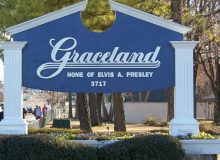
Eventually, the situation reached a tipping point. The neighbours even tried to buy the house from him, but Elvis—unusually for the street—had no mortgage and had paid cash, making any buyout impossible. In the end, he agreed to move on, prioritising his parents’ need for privacy over convenience. Fortunately, he quickly found Graceland, his ideal home.
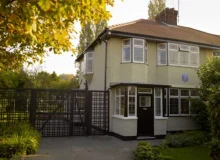
The house still stands today, though it is now more secured and fenced off than others nearby. It’s best viewed quietly from the street. And as always… Elvis has left the building.
Best Books about Memphis


RECENT POSTS